
The Pomodoro Technique for ADHD: How to Make It Actually Stick
The Pomodoro Technique can transform ADHD focus — but the standard 25 minutes often backfires. Here's how to adapt intervals, breaks, and timers to your brain.
Every productivity guide hands you the same advice: set a 25-minute timer, work, take a 5-minute break, repeat. The Pomodoro Technique is probably the most-recommended focus hack on the internet, and for good reason — for an ADHD brain, a visible ticking clock can be the difference between staring at a task and actually doing it.
But here's what the guides leave out: the standard 25-minute version often fails for ADHD, and not because you're doing it wrong. The rigid interval is built for a brain that focuses on demand. Yours doesn't work that way. The good news is that the Pomodoro Technique for ADHD doesn't have to be the textbook version — and once you adapt it to how your brain actually runs, it becomes one of the most reliable focus tools you have.
What Is the Pomodoro Technique?
The Pomodoro Technique is a time-management method built around short, timed work sprints separated by breaks. The classic recipe: work for 25 minutes (one "pomodoro"), take a 5-minute break, and after four pomodoros, take a longer 15–30 minute break. It was named after the tomato-shaped kitchen timer its creator used.
The mechanism is simple but powerful: instead of facing an open-ended, infinite task, you commit to one small, finite block of time. You're not promising to finish — just to work until the timer rings. That reframing is what makes starting feel possible.
And that's exactly why it tends to click for ADHD brains. The problem is the specific numbers, not the idea.
Why the Pomodoro Technique Works for ADHD

Before we change anything, it's worth understanding why this method maps so well onto the ADHD brain in the first place:
It makes time visible. Time blindness — the genuine difficulty feeling time pass — is one of the most disruptive parts of ADHD. A countdown timer turns abstract, formless time into something concrete you can see shrinking. (It's the same reason your brain cooperates so well late at night, when an implicit deadline does the work for you — more on that in why you're more productive at night with ADHD.)
It makes tasks finite. "Work on the report" has no edges, and edgeless tasks are paralyzing. "Work on the report for 20 minutes" has a clear finish line, which shrinks the activation energy needed to begin. This is the heart of how to start a task with ADHD: make the first step small enough that your brain stops treating it as a threat.
It creates urgency. A running timer supplies the external pressure your brain struggles to generate internally. Mild, friendly urgency is often enough to tip you past the starting line.
The hard stop gives permission to rest. Knowing a break is coming makes the work feel survivable — and the break itself delivers a small hit of dopamine that helps you come back for the next round.
So the concept is genuinely ADHD-friendly. The reason it so often gets abandoned is the part nobody warns you about.
Why the Standard 25 Minutes Often Fails ADHD
Here's the honest version: the textbook 25/5 rhythm assumes you can focus the instant the timer starts and that 25 minutes is the right dose for everyone. Neither is true for most ADHD brains.
For many people with ADHD, it takes a while — sometimes 20 to 40 minutes — to actually drop into deep focus. If your timer rings right as you're finally getting in the zone, the technique is literally interrupting your best work. The break becomes a derailment instead of a reward, and you lose the thread entirely.
On the flip side, on a low-energy day, 25 minutes can feel impossibly long before you've even started. The same rigid number that's too short when you're engaged is too long when you're not.
And then there's the shame spiral. You "fail" a pomodoro — you got distracted, the timer rang and you'd done nothing — and the technique starts to feel like one more system you can't stick to. That guilt does more damage than the lost time.
None of this means Pomodoro doesn't work for ADHD. It means the standard configuration doesn't — and if it keeps not sticking for you, that's usually one of a few fixable reasons. So change it.
How to Adapt the Pomodoro Technique for Your ADHD Brain
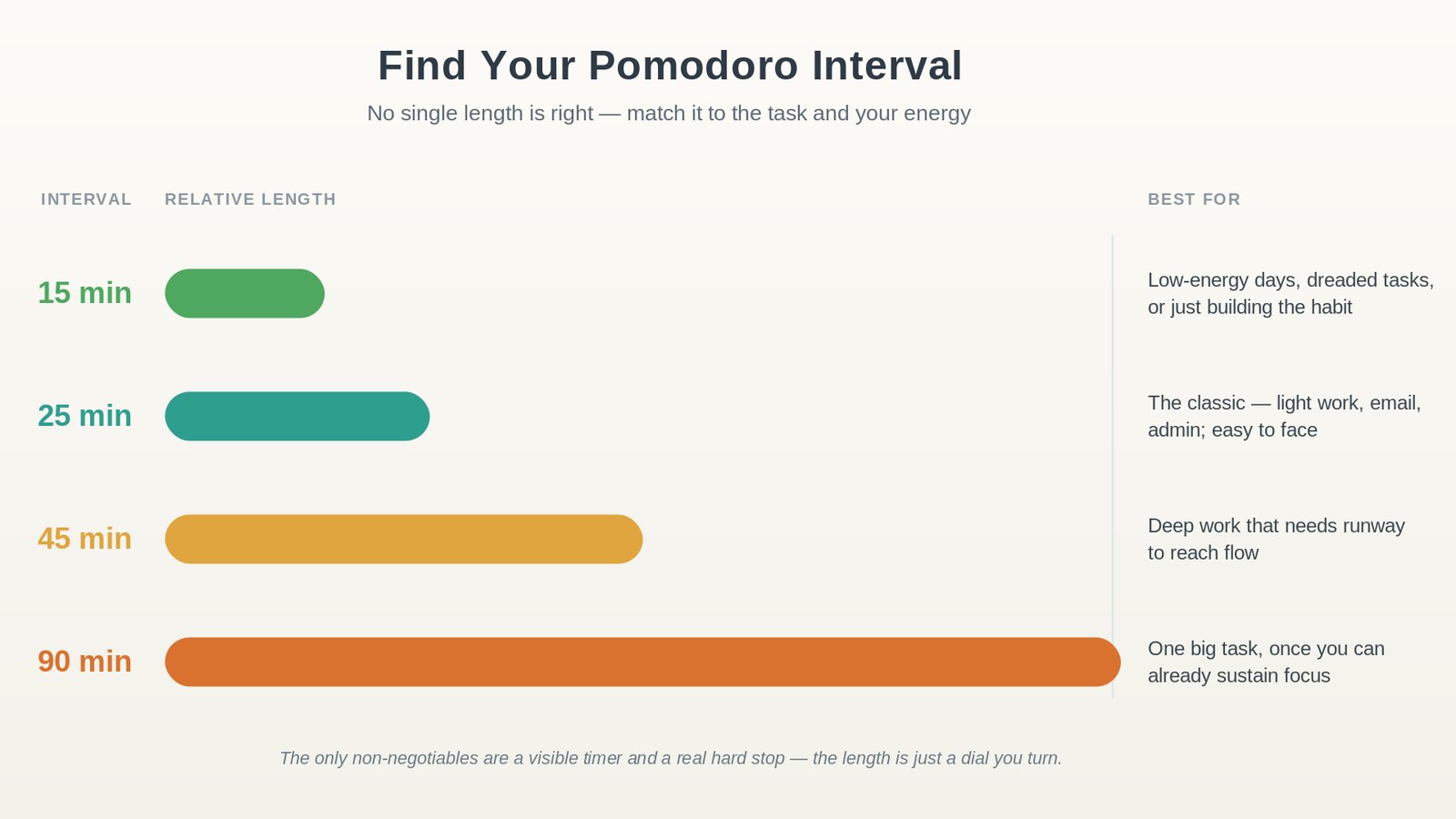
The only two things that are truly non-negotiable are the timer and the hard stop. Everything else is adjustable — so adjust it.
Find your interval, don't inherit it. Twenty-five minutes is a starting suggestion, not a law. Many ADHD adults do better with longer 45–60 minute blocks that give them room to reach deep focus before the break. Others need shorter 10–15 minute sprints, especially on low-focus days or for tasks they're dreading. Experiment for a week and notice when the timer feels like a help versus an interruption. (Here's which interval suits which task.)
Match the interval to the day, not just the task. Your focus capacity isn't fixed — it shifts with sleep, stress, and medication. A flexible approach beats a fixed one: short sprints when you're struggling, longer blocks when you're engaged. Treating the interval as a dial you turn, rather than a rule you obey, is what makes it sustainable.
Let "starting" be the only goal. The point of a pomodoro isn't to finish the task or even to stay perfectly focused. It's to begin. If you sat down and worked for most of the block, that's a win — full stop.
Make Your Breaks Actually Work

The break is half the technique, and it's where a lot of ADHD pomodoros fall apart. The danger is obvious: you "take a 5-minute break," open your phone, and forty-five minutes later you surface from a scrolling hole with no idea where the time went.
The fix is to make breaks active and bounded:
- Move your body. Stand up, stretch, walk to get water, do ten jumping jacks. Physical movement resets your nervous system far better than a screen does.
- Avoid the dopamine traps. Social media, news, and games are designed to capture attention and won't let it go — the worst possible choice for a 5-minute break. Keep the phone in another room during sprints if you can.
- Set a timer on the break too. The same hard stop that ends your work block should end your rest, or the break quietly eats your afternoon.
A good break leaves you ready to start the next sprint. A bad one ends the session.
Stack Sound With Your Sprints
The Pomodoro Technique gets noticeably stronger when you pair it with a consistent audio cue. A steady soundscape tells your brain "focus is happening now," and starting it becomes part of the ritual that launches each sprint.
What you use is personal: brown or white noise to mask distractions, instrumental music for a dopamine lift, or binaural beats if you focus better with headphones on. The key is consistency — the same sound, every sprint, so your brain learns the association. Timer plus sound is a stronger cue than either one alone.
The No-Shame Restart

This is the mindset shift that makes the whole thing last: a broken pomodoro is not a failed day.
You will get distracted mid-sprint. You'll skip the timer some days entirely. You'll have stretches where the whole system falls apart. That's not evidence that Pomodoro doesn't work for you — it's just a normal day with an ADHD brain. The skill isn't perfect consistency; it's restarting without the narrative that you've ruined anything. Reset the timer, pick one small thing, and begin again. (If the bigger problem is that everything feels like too much to even start, that's its own thing — see ADHD overwhelm and task paralysis.)
Tools: Timers, Visual Clocks, and Apps
You don't need anything fancy to start — a kitchen timer or your phone clock works. But a few tools fit the ADHD brain especially well:
- A visual timer or clock. Seeing time physically disappear (a shrinking colored disc, a countdown bar) is far more effective for time blindness than a number you have to read and interpret.
- A simple Pomodoro app or planner. Something that runs the intervals and breaks for you removes the friction of managing the clock yourself. The trap to avoid is the over-featured app with endless settings — you'll spend your focus time configuring it.
That last point is exactly why Steady Station exists. Instead of a sprawling Pomodoro app with a dozen menus, it pairs an ADHD-tuned Pomodoro timer with a focus soundscape and a simple task list, in one screen. You pick a task, press go, and the timer, sound, and break structure all run together — no setup, no decisions, nothing to configure before you've started. For an ADHD brain, fewer choices at the starting line is the whole point, and it's part of the broader toolkit in how to be productive with ADHD.
FAQ
Does the Pomodoro Technique work for ADHD? For many people, yes — it externalizes time and makes tasks finite, which directly addresses ADHD's time blindness and trouble starting. The catch is that the standard 25-minute interval often needs adjusting; a flexible, no-shame version works far better than the rigid textbook one.
How long should a Pomodoro be for ADHD? There's no single right number. Try longer 45–60 minute blocks if you need time to reach deep focus, or shorter 10–15 minute sprints on low-energy days or for tasks you're avoiding. The timer and the hard stop matter more than the exact length.
Why does the Pomodoro Technique fail for some people with ADHD? Usually because of the rigid 25-minute interval. It can cut off a session right as deep focus arrives, feel too long on low-focus days, and create shame when a pomodoro gets "broken." Adapting the interval and dropping the all-or-nothing mindset fixes most of this.
Is the Pomodoro Technique good for studying with ADHD? Yes — timed sprints with breaks help with reading and studying by breaking big, open-ended material into finite chunks. Pair it with a consistent focus sound and pick an interval that lets you get absorbed before the break interrupts you.
The Bottom Line
The Pomodoro Technique for ADHD works — just not the version printed on the box. Keep the two things that matter (a visible timer and a real hard stop), throw out the rigid 25-minute rule, build breaks that actually restore you, and forgive the broken sprints. Do that, and you've turned a generic productivity hack into something genuinely built for the way your brain handles time.
Start with one sprint today. Pick a length that feels almost too easy, set the timer, and just begin. (And if the fixed-interval approach never clicks, compare Pomodoro with Flowtime and time blocking.) Starting is the whole game — everything after that is momentum.
Ready to find your focus?
Steady Station is a distraction-free soundscape and Pomodoro timer built for ADHD minds.
Try Steady Station for free →