
Binaural Beats for Focus: Do They Actually Work for ADHD?
Do binaural beats actually help you focus — or for ADHD? Here's what the science says, which frequencies matter, how to use them, and whether they're safe.
If you've gone looking for a way to focus, you've almost certainly stumbled onto binaural beats — those YouTube videos and apps promising laser concentration if you just put your headphones on and press play. The claims range from "instant focus" to "study like a genius," which is exactly the kind of thing that should make you skeptical.
So let's do the honest version. What are binaural beats, do binaural beats actually work for focus and ADHD, which frequencies are supposed to help, and are they even safe? Here's what the research says — and what it doesn't.
What Are Binaural Beats?
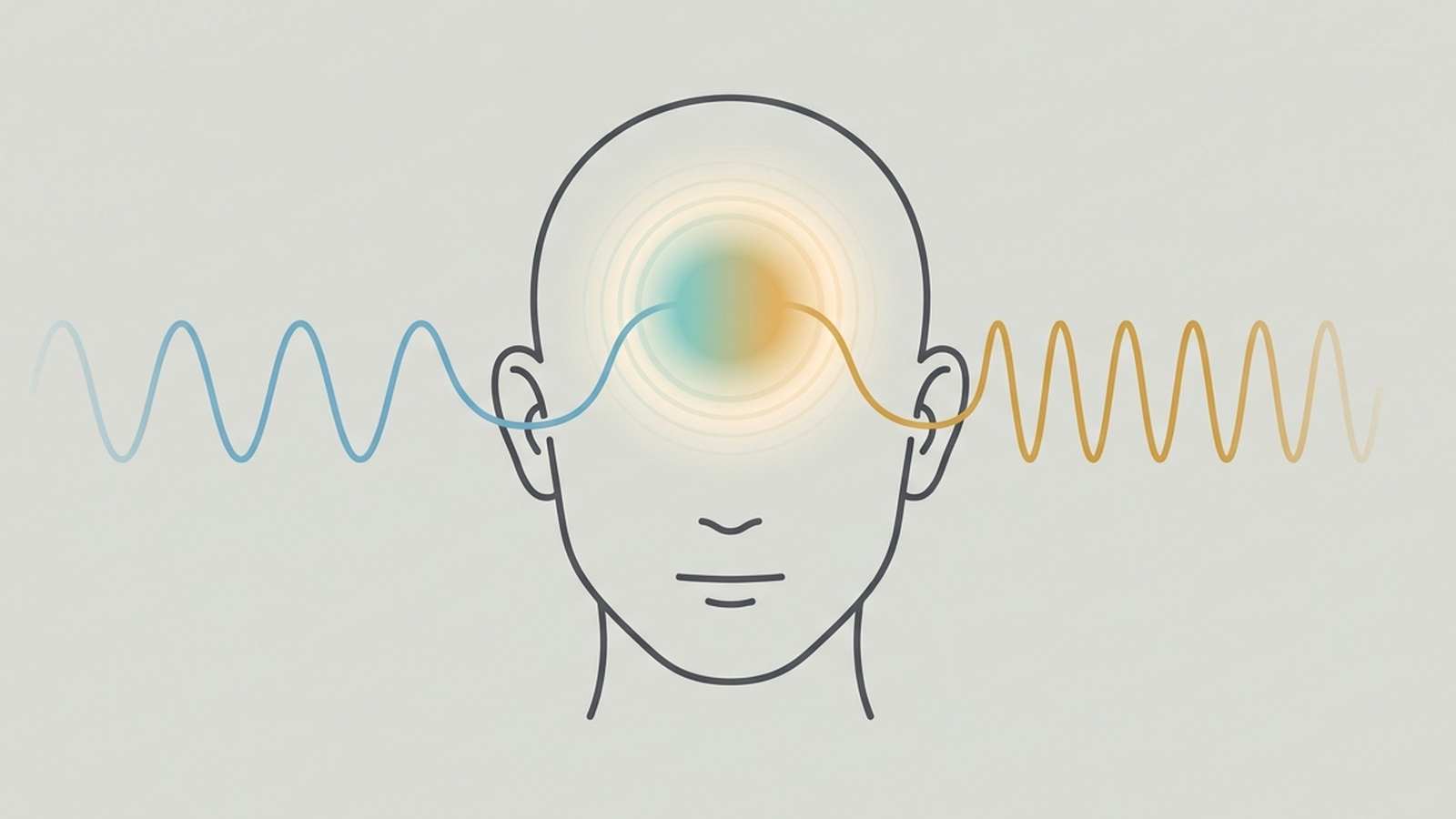
A binaural beat is an auditory illusion. When you play a slightly different frequency in each ear — say 200 Hz on the left and 210 Hz on the right — your brain doesn't hear two separate tones. It perceives a third, pulsing "beat" at the difference between them: in this case, 10 Hz. That phantom 10 Hz pulse is the binaural beat, and it only exists inside your head.
Because the effect depends on each ear receiving a different tone, binaural beats require stereo headphones. Played through a speaker, the two frequencies mix in the air before they reach you, and the illusion collapses. This is the single most important practical fact about them, and it's the reason a lot of people who "tried binaural beats and felt nothing" weren't actually hearing binaural beats at all.
The theory behind why they might help is called brainwave entrainment — the idea that your brain's electrical activity will gradually sync up to the frequency of the beat. Play a focus-range beat, the theory goes, and your brainwaves drift toward a focus-range state. It's a tidy idea. Whether it actually happens that way is where things get more complicated.
The Brainwave Frequencies (and Which Ones Matter for Focus)
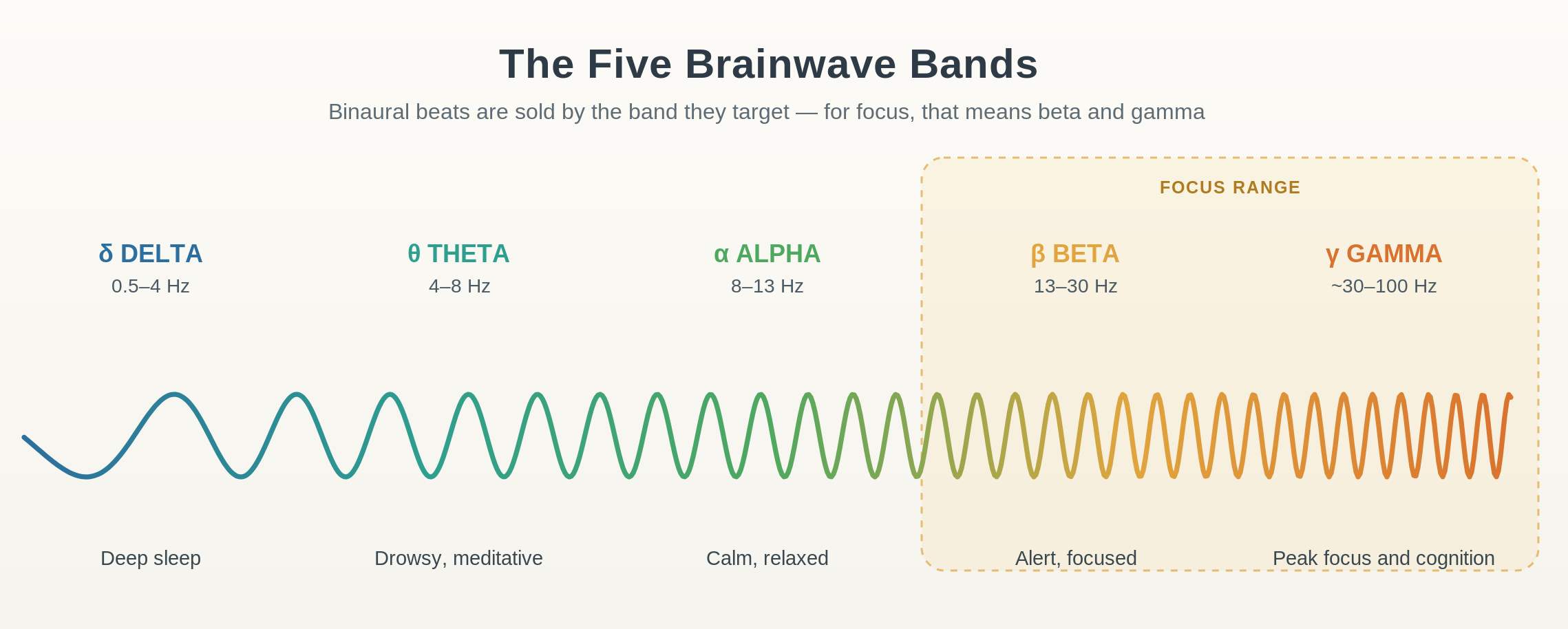
Your brain produces electrical activity at different frequencies depending on what you're doing. Binaural beats are usually marketed by which of these bands they're meant to target:
- Delta (0.5–4 Hz) — deep, dreamless sleep.
- Theta (4–8 Hz) — drowsiness, deep meditation, the edge of sleep.
- Alpha (8–13 Hz) — calm, relaxed wakefulness; reduced anxiety.
- Beta (13–30 Hz) — alert, engaged, actively concentrating. This is the band most associated with focus and problem-solving, which is why beta brain waves are the usual target for binaural beats for focus.
- Gamma (~30–100 Hz) — high-level cognition and attention. The popular 40 Hz binaural beats fall here, and gamma is the band most studied for sustained attention.
So if you're chasing concentration, the binaural beats frequencies that make sense are in the beta and gamma ranges (roughly 14–40 Hz). The low, soothing delta and theta tracks are built for sleep and relaxation — pleasant, but the opposite of what you want when you're trying to power through work. (This is also why the scary "is a low-Hz beat dangerous?" searches are misplaced — a low-frequency beat isn't dangerous, it's just sleepy.)
Do Binaural Beats Actually Work for Focus and ADHD?
Here's the honest answer: the evidence is mixed and still thin, but it's not nothing — and it's been getting a little more interesting lately.
The case for cautious optimism. A 2025 parametric study in Scientific Reports found modest evidence that starting binaural beats about 10 minutes before a task helped blunt the normal decline in vigilance over time — and that performance was best when binaural beats were combined with white noise. Earlier work using a focused-attention task also found people directed their attention more tightly while listening to certain binaural beats. And for ADHD specifically, a small 2022 pilot found improved study performance in university students with ADHD.
The case for skepticism. These are small studies, the results don't always replicate, and some research finds no effect at all. As Healthline notes, formal research on binaural beats for ADHD is limited, and the brainwave-entrainment mechanism is far from proven. A lot of the enthusiasm online is anecdotal.
Where does that leave you? In roughly the same place as brown noise versus white noise: the formal evidence is modest, individual responses vary a lot, and the real test is whether it works for your brain. The upside is that binaural beats are low-cost and low-risk, so they're a reasonable thing to experiment with — as long as you go in with realistic expectations rather than "this will fix my focus."
It's also worth knowing that a good chunk of any benefit may simply come from the audio acting as a consistent, distraction-masking backdrop — the same reason ambient sound helps in the first place. Which raises a fair question: are binaural beats actually better than the alternatives?
Binaural Beats vs Brown Noise vs Music
These three get lumped together, but they work differently and suit different situations.
- Binaural beats aim to nudge your brain state through that two-tone illusion. They require headphones, and the experience is more abstract — many people find the steady tones either soothing or slightly odd.
- Brown and white noise mask distractions with a steady wash of sound. No headphones required, strong research for general focus, and easier for most people to tolerate for hours. (The full breakdown is in brown noise vs white noise.)
- Music can boost dopamine and mood, but lyrics and big dynamic shifts compete for attention — so instrumental only. More on that in music for ADHD focus.
For an ADHD brain, the practical move isn't picking a winner — it's testing each and noticing which one you stop hearing once you're working. Some people even layer them: a focus-range binaural beat under a soft noise bed, which is roughly what that 2025 study found most effective.
How to Use Binaural Beats (the Right Way)

If you want a fair trial, the details matter:
- Use stereo headphones. Non-negotiable — the effect doesn't exist without separate tones in each ear. Earbuds are fine as long as both sides are in.
- Pick a focus-range track. Look for beta (around 14–30 Hz) or 40 Hz gamma beats if your goal is concentration. Skip the delta/theta "deep relaxation" tracks for work.
- Give it 10–15 minutes. Don't judge it in the first 30 seconds. Research that found a benefit often started the audio before the task, so put it on, then begin.
- Keep the volume moderate. Loud doesn't mean more effective — it just means more fatigue. The beat should sit in the background.
- Pair it with structure. Audio alone rarely fixes focus. Binaural beats work best as one layer of a focus setup — a clear task and a timer doing the heavy lifting. (See how to start a task with ADHD for the activation side.)
A note on apps and generators: plenty of binaural beats apps and YouTube channels exist, and most are free. The catch is the usual ADHD trap — twenty minutes lost choosing the "perfect" track. If that's you, the fix is fewer choices, not more. Steady Station takes the opposite approach to a sprawling binaural beats app: a small set of focus soundscapes paired with a Pomodoro timer and a task list, so you press go instead of browsing.
Are Binaural Beats Safe?
For the vast majority of people, yes — binaural beats are safe. They're just sound. They won't damage your brain, rewire your personality, or do anything permanent, despite some of the more dramatic things you'll read online. The main sensible precautions are ordinary ones:
- Keep the volume moderate to protect your hearing over long sessions — the same as any headphone listening.
- If you have epilepsy or a seizure disorder, check with your doctor first. Rhythmic auditory (and visual) stimulation is worth clearing with a professional in that case, out of caution.
- If it makes you feel anxious, dizzy, or just "off," stop. That's uncommon, but your own response is the only feedback that matters.
That's the whole risk profile. Binaural beats are firmly in the low-stakes category — which is exactly why they're worth a try if you're curious.
FAQ
Do binaural beats work without headphones? No. The effect depends on each ear receiving a slightly different frequency, which only happens with stereo headphones or earbuds. Through a speaker, the tones blend before they reach you and there's no binaural beat.
How long does it take for binaural beats to work? Give it at least 10–15 minutes. In studies that found a benefit, the audio was often started several minutes before the task began, so put it on first and then start working rather than expecting an instant switch.
Which Hz is best for binaural beats for focus? Beta-range beats (roughly 14–30 Hz) and 40 Hz gamma beats are the ones associated with alertness and concentration. Lower delta and theta frequencies are designed for sleep and deep relaxation, so they're the wrong choice for work.
Are binaural beats safe? Yes, for most people — they're just sound and won't harm your brain. Keep the volume moderate to protect your hearing, and if you have epilepsy or a seizure disorder, check with your doctor before using rhythmic auditory stimulation.
The Bottom Line
Binaural beats for focus aren't magic, and the science is still catching up to the hype. But the evidence points to a modest, real possibility of benefit for some people — especially in the beta and 40 Hz gamma ranges, used with headphones, given a few minutes to settle in. They're cheap, low-risk, and easy to test, which makes them a perfectly reasonable thing to add to your focus toolkit.
Just don't expect the audio to do the whole job. Sound is a backdrop; what actually moves the needle for an ADHD brain is a clear task, a visible timer, and an environment with fewer decisions in it. Get those in place, add whatever sound helps you disappear into the work, and you've got something far more reliable than any single track.
Ready to find your focus?
Steady Station is a distraction-free soundscape and Pomodoro timer built for ADHD minds.
Try Steady Station for free →