Why You're More Productive at Night With ADHD (and How to Hack It)
Your ADHD brain focuses best at 2AM for real scientific reasons. Learn why — and 5 ways to recreate that late-night focus during the day without losing sleep.
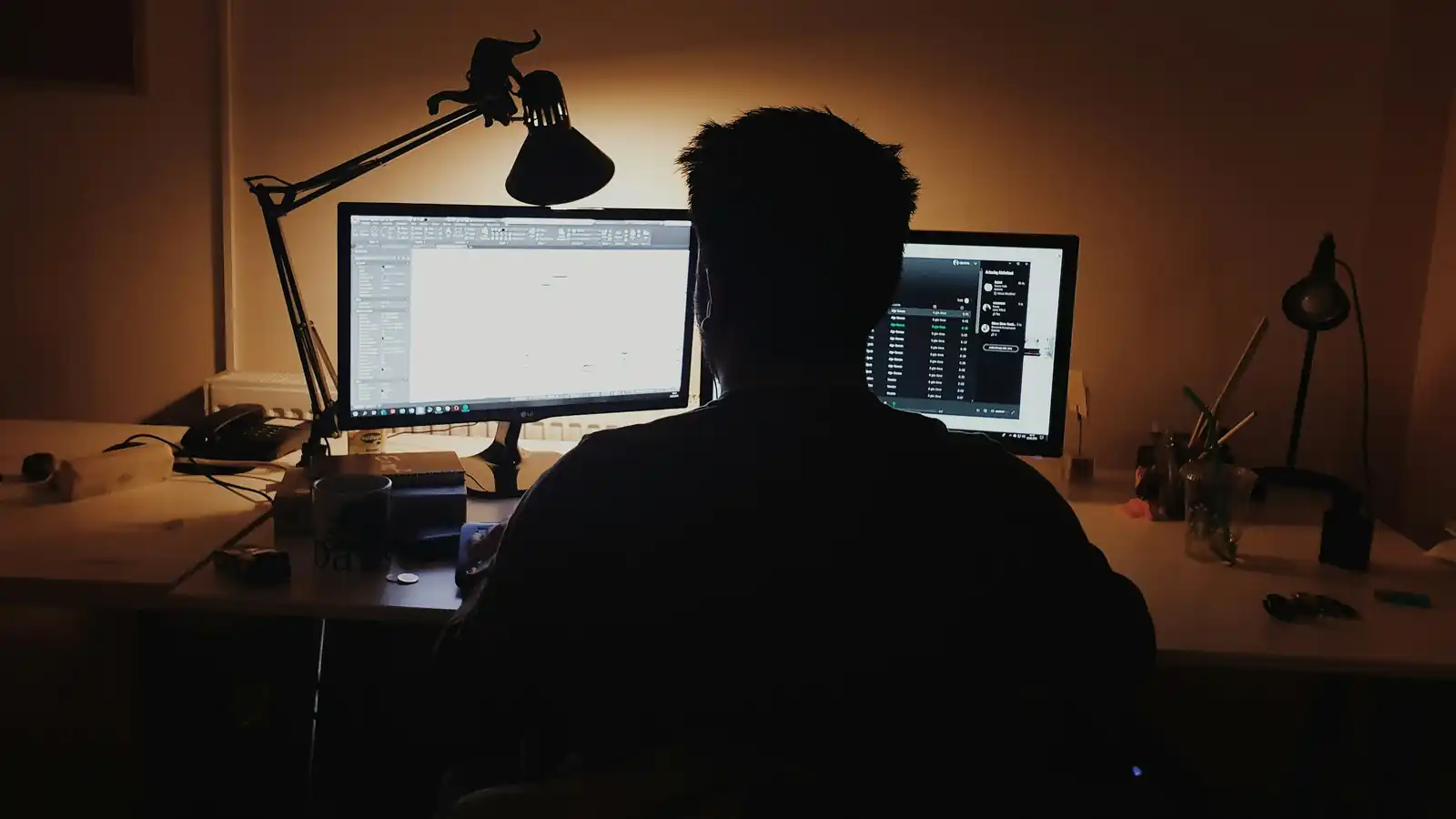
You know the feeling. It's midnight. The house is quiet. Your phone has stopped buzzing. And suddenly — almost magically — your brain decides to cooperate. Words flow. Ideas connect. Tasks that felt impossible at 2PM are effortless at 2AM.
If you have ADHD and keep asking why am I more productive at night, this isn't a coincidence. It's neuroscience.
The late-night productivity surge is one of the most common experiences shared by people with ADHD. Online forums, therapist offices, and group chats are full of the same confession: "I can only focus at night." It feels like a personal flaw — another way your brain refuses to work on society's schedule. But it's not a flaw at all. It's your brain responding to a very specific set of conditions that happen to align perfectly after dark.
The good news? Once you understand why it happens, you can start recreating those conditions during daylight hours.
Your Brain Isn't Broken — It's on a Different Clock
Let's start with biology. Research published in Frontiers in Psychiatry has found strong evidence that ADHD functions, at least in part, as a circadian rhythm disorder. An estimated 73 to 78 percent of children and adults with ADHD have a delayed sleep-wake cycle, meaning their internal body clock runs roughly 1.5 hours behind the average person's.
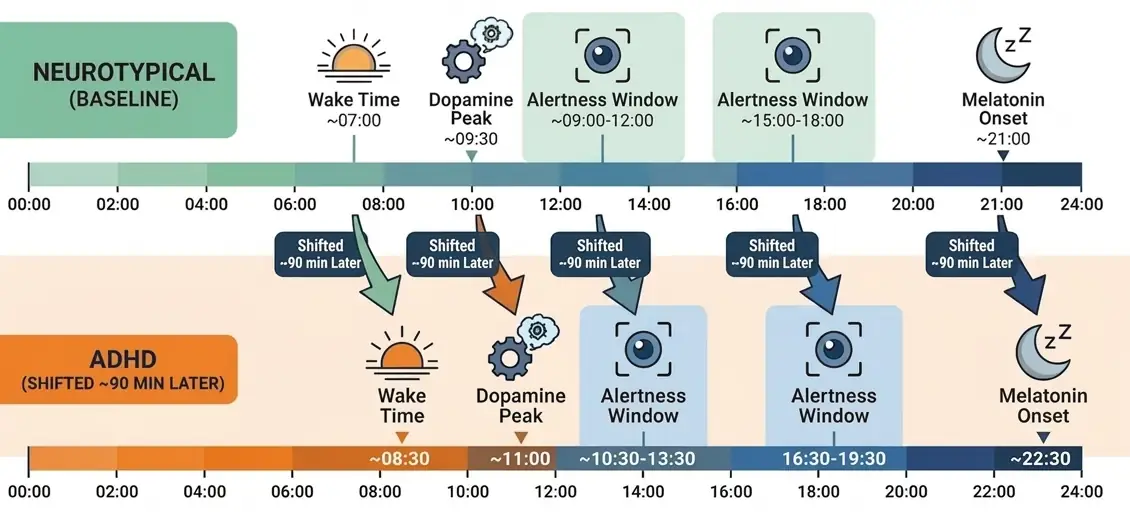
This delay has a direct chemical cause: melatonin. In most adults, melatonin — the hormone that signals sleepiness — begins rising in the early evening. In adults with ADHD, that onset is delayed by an average of 90 minutes. Your body simply isn't ready for sleep when society says it should be. While everyone else is winding down at 10PM, your brain is just warming up.
But it goes deeper than melatonin. Dopamine, the neurotransmitter most closely linked to ADHD, plays a central role in regulating your circadian rhythm. People with ADHD typically have lower baseline dopamine levels, which makes daytime focus a constant uphill battle. Dopamine is primarily synthesized and released during the day, but it has an inhibitory relationship with melatonin — the two essentially take turns. When your melatonin schedule is shifted later, your dopamine activity shifts with it.
The result? Your brain's peak chemical conditions for focus don't arrive at 9AM. They arrive closer to midnight.
It's Not Just Chemistry — It's the Environment
Biology sets the stage, but the environment seals the deal. And this is where things get really interesting for anyone trying to hack their daytime focus.
Think about what 2AM actually looks like. No one is texting you. No emails are coming in. The street outside is quiet. Your family is asleep. Social media has slowed to a trickle. The world, for once, has stopped demanding your attention.

For a brain that struggles to filter out irrelevant stimuli — which is a core feature of ADHD, not a personal weakness — this is transformative. During the day, your executive function is constantly working overtime: processing conversations, filtering background noise, resisting the pull of notifications, recovering from interruptions. Each of these tasks draws from a limited pool of cognitive resources. By evening, you've been fighting distractions for 16 hours straight.
At night, with the noise removed, those resources are suddenly freed up. You don't have to work hard to focus because there's nothing competing for your attention. Hyperfocus — that state of deep, almost obsessive concentration — becomes dramatically easier to trigger when there's nothing to pull you out of it.
There's a hormonal layer here too. Cortisol, the stress hormone, naturally drops in the evening to prepare the body for rest. But in people with ADHD, cortisol patterns are often atypical: lower in the morning (which is why getting out of bed feels like moving through concrete) and relatively elevated in the evening. That cortisol bump gives you a late-day surge of alertness and mental clarity — right when the rest of the world is shutting off.
Put it all together — delayed dopamine peaks, reduced environmental noise, altered cortisol patterns — and 2AM isn't just when you happen to focus. It's when your brain is finally operating in the conditions it was built for.

The Problem With Leaning Into It
Here's the trap: knowing that you focus best at night makes it tempting to just restructure your life around those hours. And for some people, that works. If your job allows it, there's no shame in being a night owl.
But for most of us, the world doesn't wait until midnight. Meetings start at 9AM. Deadlines land at 5PM. Kids need to be dropped off at school. And the real cost of relying on late-night productivity is sleep deprivation, which worsens every ADHD symptom you're trying to manage. Executive function deteriorates. Emotional regulation suffers. Task initiation — already one of the hardest parts of ADHD — becomes nearly impossible when you're running on four hours of sleep.
The research is clear on this: chronic sleep restriction amplifies ADHD symptoms significantly. You might feel productive at 2AM, but if you're paying for it with your next three mornings, the math doesn't work out.
So the real question becomes: how do you recreate the conditions of 2AM without actually staying up until 2AM?
Hacking Daytime Focus: Recreate the 2AM Environment
The secret isn't willpower. It's environment design. Your brain focuses at night because specific conditions are met — and you can engineer those same conditions during the day.
1. Kill the Noise (Literally)
The single biggest advantage of nighttime is the absence of auditory and digital distractions. During the day, you need to manufacture that silence.
This is where ambient soundscapes become a game-changer for ADHD brains. Research has consistently shown that moderate ambient noise — particularly brown noise and pink noise — can improve focus and cognitive performance. Unlike music with lyrics (which activates language-processing areas and competes for attention), ambient sound creates a consistent auditory blanket that masks unpredictable disruptions.
Brown noise has become especially popular in the ADHD community because its deep, low-frequency tone mimics the quiet hum of nighttime. It drowns out the random sounds — a car horn, a notification ping, someone talking in the next room — that would otherwise hijack your attention.
The key is consistency. Your brain doesn't need silence; it needs predictability. A steady soundscape tells your nervous system that the environment is safe and stable, which is exactly what allows you to sink into focus.

2. Create Artificial Time Pressure
At night, there's often an unspoken deadline: you need to sleep eventually. This creates a natural sense of urgency that helps with task initiation — one of the biggest ADHD challenges. During the day, time feels infinite and formless, which is paralyzing for a brain that struggles with time perception.
The Pomodoro Technique addresses this directly. By breaking work into defined intervals — typically 25 minutes of focused work followed by a 5-minute break — you create the same kind of bounded, finite time pressure that nighttime naturally provides.
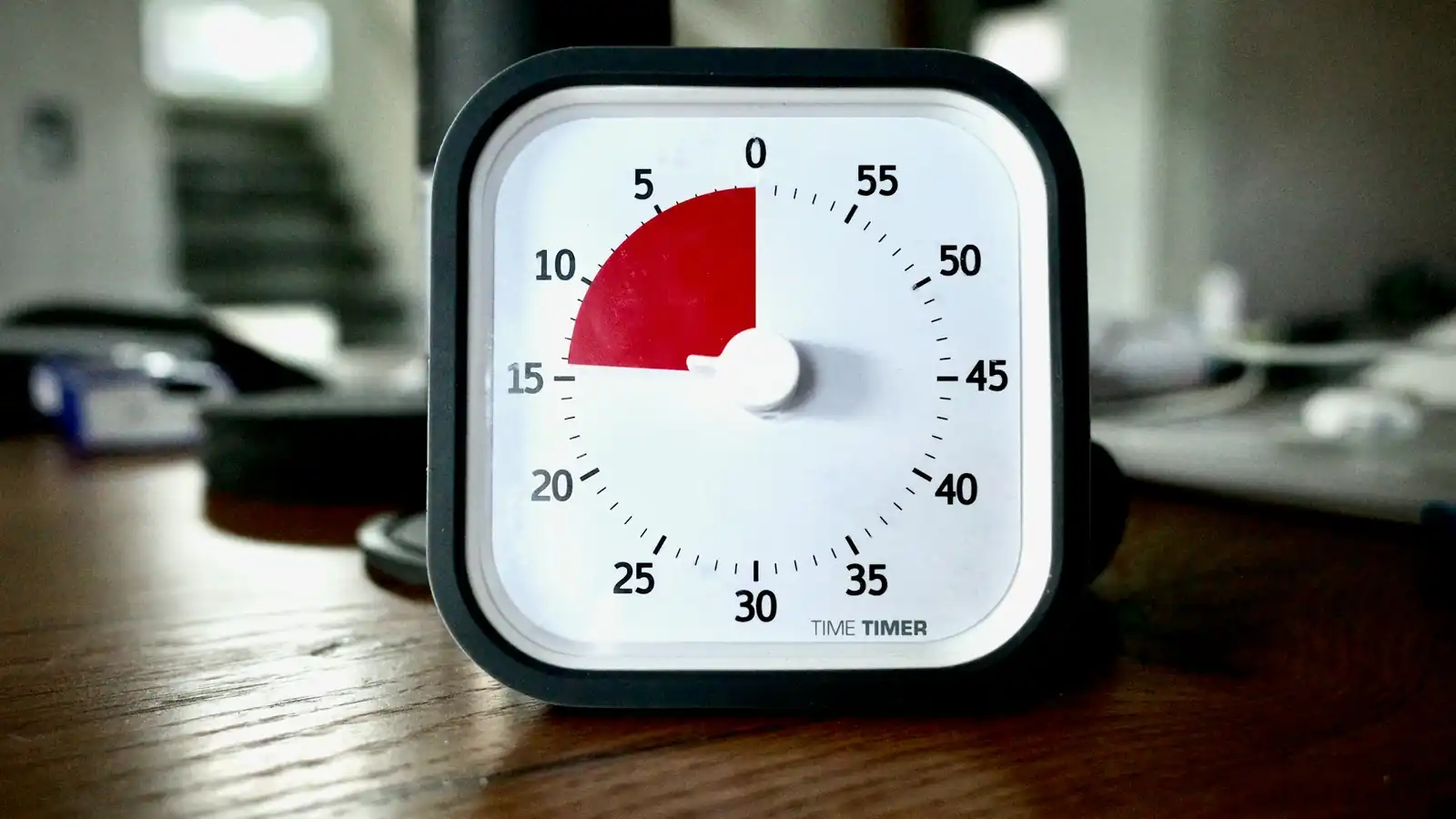
Research from the ADHD Coaches Organisation suggests that many people with ADHD actually benefit from shorter intervals of 10 to 15 minutes when first building the habit. The point isn't the specific duration — it's that the timer makes time visible and tangible. For a brain that genuinely cannot feel time passing, an external timer transforms an abstract concept into something concrete.
3. Reduce Decision Fatigue Before It Starts
Another hidden advantage of 2AM: there are no decisions left to make. You're not choosing what to eat, what to wear, or which task to do first. You've already made it through an entire day of decisions, and what's left is simple: do the thing in front of you.
During the day, you can replicate this by front-loading your decisions. Pick your tasks the night before. Use a simple, short list — not a sprawling project management tool with 47 categories. Three tasks maximum. When your focus session begins, the decision is already made. You just start.
This is why tying a task list directly to your focus sessions is so powerful. Instead of opening your work session and spending 20 minutes deciding what to do (which often turns into doing nothing), you've already committed. The only remaining action is to press play.
4. Control Your Light Exposure
Since delayed circadian rhythm is a core part of the ADHD night-owl pattern, strategic light exposure can genuinely shift your peak alertness earlier in the day. Bright light therapy in the morning — ideally within 30 minutes of waking — has been shown to help regulate melatonin onset and improve both sleep timing and daytime focus in people with ADHD.
Conversely, reducing blue light exposure in the evening (dimming screens, using warm lighting) can help your melatonin kick in earlier, making it easier to get the sleep your brain needs to function during the day.
5. Stack the Conditions
Here's what makes the biggest difference: don't use one of these strategies. Stack them.
Put on a soundscape. Start a timer. Work from a pre-made task list. Close every tab and notification. You're not just using a productivity tool — you're reconstructing the 2AM environment in the middle of the afternoon.
This is the entire philosophy behind tools designed specifically for ADHD focus: remove the choices, reduce the noise, make time visible, and create a container for your attention. Not a complex system you'll abandon in three days. A simple, opinionated environment that says: here's your task, here's your sound, here's your timer. Go.
You're Not Lazy — You're Misaligned
If you've spent years feeling guilty about being "unproductive" during normal hours while secretly accomplishing your best work at 2AM, here's what I want you to take away: there's nothing wrong with your brain. Your focus is real. Your capability is real. The problem is a mismatch between when your brain is ready to work and when the world expects you to.
You can't always change the world's schedule. But you can change your environment to match the conditions your brain is already telling you it needs: fewer distractions, predictable sound, visible time, and zero decision fatigue.
That 2AM version of you isn't a different person. It's you, in the right conditions.
Now you just need to build those conditions on purpose.
Ready to find your focus?
Steady Station is a distraction-free soundscape and Pomodoro timer built for ADHD minds.
Try Steady Station for free →